For me, an aquarium is not complete without a live plant. I love my plants as much as I love my fish!
The most important thing to know about plants is their light requirements. Beginners should only buy “low light” plants and leave the rest for the better equipped. You’ll have to buy a “full spectrum” tube or a special “flora” tube. Better yet, use a clear glass top and use two light strips. The strip in the back a “flora” tube and the tube in the front a sunlight or full spectrum tube. Whatever you choose, keep the lights on about twelve hours a day (use a timer) because many of these plants are native to tropical areas where the days are twelve hours long.
You will also need fertilizer- especially iron. Only use fertilizer made especially for aquatic plants. Most true aquatic plants get much of their nutrients directly from the water through the leaves. I’m using “Kent Freshwater Plant” fertilizer. In addition to liquid fertilizer you should also press iron rich fertilizer tablets into the gravel near the roots. You can use any gravel you want, but if you are serious about having plants in your aquarium I advise you to use gravel especially made for plants like iron rich Flourite. 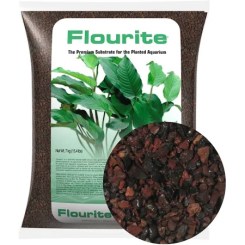 I love the dark brown color — natural looking and attractive. It is worth the extra money. Just remember to rinse it well before you put it into your aquarium, because it is dusty and will cloud the water. If that happens, use a polishing pad in the filter (it is similar to a piece of felt).
Plants also need carbon dioxide as a fertilizer, and gadgets are sold for this purpose. If you want to save money, you can “do it yourself” . Bubble it in with an air stone attached to an airline whose other end is inserted into a hole in the cap of a beverage container – you fill it about two thirds of the way with warm water, add a teaspoon of yeast and a cup of sugar; the yeast will make the carbon dioxide which will travel up the tube and 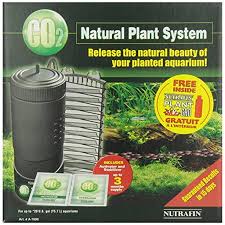 into the tank via your air stone. A better idea is to buy a Hagen Nutrafin CO2 system, which is basically the same thing but never leaks and is more effective. Don’t bother with the expensive packets, just use yeast and baking soda. Advanced aquarists use carbon dioxide canisters with pressure valves and other equipment which gets very expensive. You need a system like that for a large tank, but my 60 gallon tank does fine with just the Nutrafin system.
Just as you do for your fish, research the plant species before you buy. Some plants need hard water, some soft. Some need high pH, some need low. Some need low light, some high. Make sure the plant you buy will do well under the conditions of your own tank. Most importantly, don’t buy plants that don’t belong underwater! Believe it or not, some pet stores will sell you a terrestrial plant, hoping it will live in your aquarium (one common culprit is the spider plant).
Beginners with small tanks should stick to hardy plants that do well in low light. Your tank might look bright to you, but a lot of that light does not reach the plants because light does not travel well through water. When choosing plants, keep in mind how tall they will get and how high your tank is. Vallisinaria are a good choice for new tanks because they grow and multiply quickly. Just be careful to get the shorter ones. I prefer Saggitaria.  I like dwarf Saggitaria, Anubias, Java Fern (Microsorium pteropus), Ludwigia repens and the Cryptocorines (I like the reddish C. wendtii as pictured here). If you want to buy only one plant to toss onto the surface to float (and grow to cover the surface), get Egeria densa (anacharis). It is a nice hiding spot for babies (fry).
Live plants do have a purpose in life. Plants add oxygen to the water, and absorb some of the nitrates produced by the nitrogen cycle. They also provide food and shelter for the fish, and my Rosy Barbs are very fond of depositing their eggs at the base of the plants. Angelfish attach their eggs to the underside of leaves.
Stem plants are often sold in groups with a metal band wrapped around the base. You need to remove that band. Hold the plant under water while using a SHARP scissors to cut it off – cut well above the band, where the stems are green and healthy (the band often crushes the stems). Don’t be afraid to cut high – cut it where it’s certain to be healthy, and it will sprout new roots at the buds. (Dead roots are brown, healthy ones are white). It’s best to hold it under water when cutting, because it avoids getting air bubbles into the stems. When planting stem plants, don’t plant them in a bunch as they were sold. Separate the stems and plant them in separate locations. They will grow in – and when they get tall, you can prune off the tops and plant those too. For more information on plants, read my favorite aquarium book, “Aquarium Plants Manual” by Ines Scheurmann.
Algae
Algae grows in every aquarium and it is not a problem for the fish. Some of them, like livebearers, enjoy eating it as a snack. It is a problem for the plants if it grows on the leaves and prevents light from getting to the plant. If you have too much algae test your nitrate level. Algae feeds on nitrate and phosphate. If either of these are high you need to do more frequent water changes. Algae also may cover the hood, and prevent the lamp’s light from getting into the tank. You should wipe this off every time you clean your tank. To prevent algae, Keep your tank away from direct sunlight, have enough plants to compete with the algae for nutrients, and change the water on schedule. Include some algae eating animals in your tank, like Otocinclus affinis or, if you have a large tank, a Plecostomus (Pictured here.). 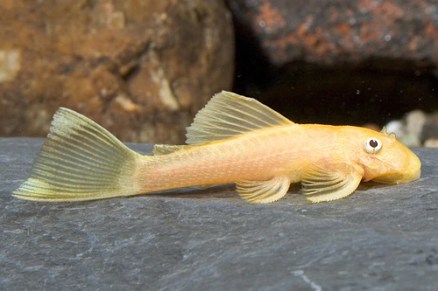 All aquarists get some algae. I scrub my glass with a Mag-Float; it is much easier to use than the traditional algae scrapers. The operative word here is “float.” If you drop the magnet into the tank it will float on the surface until you retrieve it. Don’t get a brand that sinks. I do not use algae removing chemicals – it is unnecessary and toxic. There are books and web pages that will help you identify what type of algae you have and what you can do about it.
 Aquarium School