Questions: (scroll down for answers)
How do I take care of a fishbowl, and what kind of fish can go in it?
Help! Why are my new fish dying?
Help! What should I do about a sick fish?
How many fish can I fit in my tank?
How often should I clean my filter?
How do I “cycle” my aquarium?
Do I need live plants?
What live plants are good for a beginner?
Do I need fertilizer or special lights or gravel for my plants?
What do I do about too much algae?
What species of fish can live with the ones I already have?
Emergency! My fish had babies! What do I do?
Wow. You have so many questions! Here are some answers:
Q. How do I take care of a fishbowl, and what kind of fish can go in it?
If you only have a fishbowl, you will need to keep the water healthy and the bowl clean, and to feed your fish a little bit once a or twice a day (if they don’t finish, take the extra out and feed a lot less next time). To keep a fishbowl clean, you’ll need an extra container to put the fish in with half of it’s water. The container must be safe. By “safe” I mean one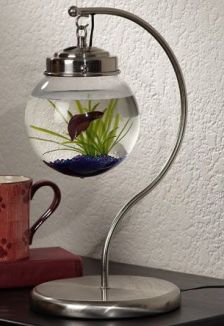 that has never had soaps, cleansers or other chemicals in it (fish are very sensitive – every thing you use should have been purchased specifically for your fish and must never have been used for anything else). Then pour out the other half of the water from the fishbowl and rinse the gravel in DECHLORINATED water to get the gunk off the bottom. DO NOT USE SOAP OR DETERGENT! Just rinse it with dechlorinated tap water. You dechlorinate the water with Stress Coat or other additive. Fill the bowl partly with fresh dechlorinated water that is the same temperature as the water the fish in sitting in; then pour the fish and its half of the water back into the fresh bowl. That’s it! You have just cleaned the bowl and changed half of the water. You are supposed to do this at least once a week, but if your fish is a goldfish, you will have to do it every day. You should not put a Goldfish in a bowl; goldfish get large and need a lot of water. For a bowl, you are better off with a Betta. Bettas will survive at room temperature, but they rather be at 80ºF. (That is 26ºC.). My Bettas are in five gallon heated tanks, and they seem to be happy with that. Don’t go smaller than one gallon – the temperature and water chemistry get less stable the smaller you go. Just because the pet store sells tiny Betta containers doesn’t mean they are a good idea. Get the largest bowl you can. You should have test strips or kits so you can check the water for ammonia and nitrite.
Q. Help! Most of the fish in my new aquarium are dying! Why?
A. You probably did not “cycle” it. Measure the Ammonia and Nitrite levels. If either of these are present, they are poisoning your fish. Do partial water changes until the ammonia and nitrite levels come down to zero. Add Nite Out II or other biological microbe lift to the filter, and ammonia absorbing chips. Now read my chapter about The Nitrogen Cycle and Water Chemistry.
Q. Help! My fish is sick. What should I do?
A. First check the water! Test for ammonia and nitrite and nitrate, check the pH, hardness (GH and KH), and temperature, make sure you are doing regular water changes (about 20%) and that your fish have oxygen (are they hanging at the surface trying to breathe? are they huddled by the heater trying to keep warm?) Make sure you have vacuumed the gravel on a regular basis (monthly) and that you are not over feeding. Correct any problems. Second, observe the symptoms: does it look different, does it act different? Then consult a flow chart to diagnose the trouble. Only after all of that is done should you write to a web forum, because the folks there need to know all that information before they can give you advice. Never use medicine if you have no idea what the fish has! Medicine is toxic, and can do more harm than good. Sometimes the fish is better off if you leave it alone and do nothing. Like people, they can get better on their own sometimes. If the fish needs medication, you will have to decide if you will put it in your hospital tank (you do have one, right? Of course you do, you learned ahead of time.) Moving the fish from one environment into another is stressful for the fish, and the move may make the fish more sick than it was before, so don’t move it if you don’t have to. Move it if it is contagious or if the medicine you will use is toxic or staining to your main tank.
Q. How many fish can I fit in my tank?
A. That depends on what kind of fish you have. Some need more territory than others. Some want to be alone and some want to school. If you are getting schooling fish, you need to plan for how many of them you need before you can plan the rest of your tank. For small community fish as listed in the Community Fish chapter, a good rule of thumb is one US gallon for each one inch of fish (not including the tail fin). That is about four liters for each 2.5cm of fish. This rule is for small fish (under four inches).
Larger fish don’t follow that rule at all, because they get fatter as well as longer, and need more water and oxygen. Rules for larger fish are shown on a chart I have in a book by Mike Wickham, A Guide to Fresh Water Aquariums (a very good book, now out of print, but you should search for newer ones he has written). His chart is as follows: A one inch fish needs one gallon of water; a two inch fish needs two gallons of water; a four inch fish needs five gallons of water; a six inch fish needs more than ten gallons of water, and a twelve inch fish needs over fifty gallons of water for that one fish. Of course, the fish are better off the more water you have for each one.
You can fit more fish in a long tank than a tall one, because SURFACE AREA IS IMPORTANT when making this decision. The surface is where the oxygen gets in and the toxic gasses get out, so more is better. Circulation is important for the same reason – without bubbles, you fit fewer fish than with them. When in doubt, use less fish and more filtration! Overcrowding can stress and kill your fish. Extra filtration is always good. ALWAYS BUY A BIGGER TANK than you think you need, because we all get tempted to buy a new fish later on; also larger tanks are more stable and easier to keep than small ones. When matching a tank to your fish, remember to plan how large your fish will grow, not what size they are when you buy them. A one inch fish can turn into a twelve inch fish in one year! Research your fish before you buy them!
Q. How often should I clean my filter?
A. Again, this depends on how many fish you have. The more fish and live plants you have, the more often you will need to clean the filter. In general, once a month is fine. Be sure to rinse the media if the water seems to be falling over it instead of through it – that means it is clogged with gunk. The important thing to know is that cleaning it too much is worse than not cleaning it enough. Don’t put in brand new filter media every time. New foam blocks or floss and new activated carbon have no nitrite/ammonia consuming bacteria on them. No “nitrobacter” nor “nitrosomonas.” You must have those little guys! Use ceramic “Biomax” or other biological filter media and rinse the media in old tank water because fresh chlorinated water will kill the bacteria. Only buy new media when absolutely necessary – you won’t need new ceramic balls – you want to keep those microbes! My Aquaclear foam blocks get changed about twice a year. You only need new activated carbon when the tank smells strange or when you have finished using medicine. By the way, be careful any medicine you use says that it is safe for your biofilter. If not, use the hospital tank! If the biofilter is inadequate or injured, you can add a little Nite Out II to help it along. Once it’s going, you don’t need that. When you change the activated carbon, don’t use a new foam block at the same time, and vice versa. Rinse the ceramic beads (BioMax and the like) in dechlorinated water. Chlorine will kill the bacteria colony you are working so hard to build! Keep the biofilter going by not removing all the nitrobacter and nitrosomonas at once. After cleaning the filter, monitor ammonia and nitrite levels to make sure your biofilter is adequate. If not, make daily or twice daily partial water changes until the nitrobacter and nitrosomonas repopulate. Add a microbe lift like Nite Out II to help it along.
Q. How do I cycle my new aquarium?
A. To “cycle” the aquarium means to build up a population of nitrobacter that will eat the ammonia and nitrite the fish put out as wastes, so these chemicals won’t build up and poison your fish. There are a few ways to do this. You need to have something for these bacteria to grow on – the foam blocks and activated carbon in the filter have a lot of surface area that colonies of these bacteria will cling to. You also must provide them with food. These bacteria occur naturally in the tank, but not in great numbers until you feed them and give them time to reproduce. They eat ammonia, so you have to add that to the new tank. Most people don’t put ammonia directly into the tank, although it has been done – there is a recipe for how much to use and how often – search the web. Most people don’t do it that way. The traditional way is to put in a few hardy fish, and let their waste products feed the nitrobacter until the ammonia level peaks, followed by the nitrite level. When both of these go back down to zero, it is safe to put in new fish. I don’t like this method, although I have used it before, because it is stressful to the fish. Why start out your new tank with stressed fish that may get sick? It’s stressful enough moving into a new home, poisons will only make it worse. Instead, some people use fish food. A pinch a day and in a few weeks you’ll measure some ammonia and then some nitrite and then they will go back to zero and it will be safe to put in your first few fish. Keep measuring the levels, and you should see those first fish suffer no toxins at all. After a week or two, put in some more fish. Repeat, always testing, until all the fish you want are in. No matter how you do it, always check the ammonia and nitrite levels and NEVER PUT ALL YOUR NEW FISH IN AT ONCE. That will kill them, because you won’t have a big enough colony of nitrosonomas to eat all the ammonia those extra fish will be creating. Remember to also check your nitrate levels, and change the water to keep them down. Read the chapter on “Water Chemistry 101” for more information on The Nitrogen Cycle.
Q. Do I need live plants?
A. That depends on what kind of fish you have. Guppies and livebearers need live plants. Angelfish need live plants (they lay eggs on the underside of leaves). Some fish need live plants to hide in. Research your fish. For most fish, artificial plants are fine.
Q. What live plants are good for a beginner?
A. Like fish, different species of plants have very different needs. For beginners I suggest hardy plants that grow well in low light, since other plants need special lighting.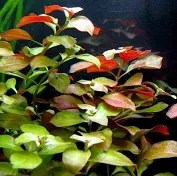 I like dwarf Saggitaria, Anubias, Java Fern, Cryptocorines (I like the reddish C. wendtii) and Ludwigia repens (pictured here). If you want to buy only one plant to toss onto the surface to float (and grow to cover the surface), get Egeria densa (anacharis).
Q. Do I need fertilizer or special lights or gravel for my plants?
A. Plants must have a full spectrum light, and/or a light made specifically for plants. You can buy these fluorescent tubes in the pet store (they are usually called “Flora” something). You would be better off with two tubes, a flora tube in the back for the plants and a full spectrum sunlight tube in the front for the observer. Don’t worry too much about the gravel – for easy plants all you need is enough regular gravel to hold the plant down, and iron rich fertilizer tablets to bury near them. Of course plants are much better off with an iron rich gravel made for aquarium plants like Flourite. I like the special plant gravel because the plants do much better in it and I love the natural dark brown color. One caveat about Flourite: it is very dusty and will cloud your water even if you washed it well, so you have to put a “water polishing” pad in the filter for a few days.
You will need fertilizer — make sure what you buy is special fertilizer made for aquariums. You should also fertilize with carbon dioxide. If you have a small tank and don’t want to buy expensive carbon dioxide set ups you can do what I do. I use a Hagen Nutrafin Natural Plant System. This is a little container that hangs off the back of the tank. You put sugar, yeast and baking soda in the container with warm water and the yeast eat the sugar and release carbon dioxide bubbles into the aquarium as a result of fermentation. They sell special packets to “recharge” the canister but they are expensive and you don’t need them. Just use baking soda and yeast instead.
Q. Help! I have too much algae!
A. Don’t worry about it. The fish like it just fine. You don’t because it looks ugly. It may be a warning sign that there is too much nitrate or phosphate in the water. Make sure your water is okay – enough light, but not too much, no direct sun, good pH, low nitrate (due to regular water changes) and a clean environment. If all that checks out, don’t worry; just scrape it off (I love my Mag-Float algae scraper!). It is also nice to have algae eating fish, just make sure your tank has room for them (Plecostomus can get huge, and even the few inches of a school of Ottos takes up tank space!). Avoid algae removing chemicals if you can. For more detailed information, check my Plants And Algae chapter.
Q. What species of fish can live with the ones I already have?
A. Well, what do you already have? Fish with fancy fins like Bettas or Guppies may get their fins torn up by other fish, but that depends on your fishes’ temperaments. Get to know your fish – some individuals are too shy or mean to play well with others, even if their species in general is supposed to do well. Most of the time, big fish eat small fish! When matching fish, match what they need. First, make sure they are called “community fish” in the books and stores. Then check if they need special water – soft vs. hard or low pH vs. high or cool vs. warm, and match that to what’s in your tank. Learn if it needs territory – my algae eater is happy in his little cave, but my male Blue Gourami wants to dominate the whole (30gal.) tank. If I had two, I’d need more room. In such a case, it is better to get a female than a competing male. Make sure the tank is big enough, both in water capacity and size of available territory, and add extra fish to a school before you add more than one that needs its own territory. You don’t only have to consider which species go together, most Community Fish do, which is why they are called “Community Fish”. You must also think about how that fish interacts with it’s own species – a fish, like some algae eaters, which get along peacefully with other fish, might get territorial if sharing a tank with its own kind. When adding a new fish, move the decorations around so each fish needs to find a new territory, rather than trying to defend the one they have against the newcomer.
Q. Help! How do I take care of new babies?
A. Congratulations! If you are finding unexpected babies, your fish are probably healthy and happy, so you are doing something right! The first question you must ask yourself is whether or not you have room for more fish tanks, because you will need one for the fry (the babies) and a bigger one for them after they have grown . If you can’t give them a good home, you are better off leaving them where they are. Maybe they will grow up, but it is more likely that they will be eaten by your other fish – but that’s okay – it’s good for your other fish! You love them, right? Live food is good for them, fun to chase around, and makes a tasty snack.
If you can give your babies a new home, put them in a separate tank with no gravel. It is a good idea to use water from the old tank in the new one, because it will be less stress on the fry, and fry are delicate. Be careful when you move fry – try to scoop up the water they are swimming in, rather than touching them with a net. Of course, they are too small for a net, so you need to use a brine shrimp net (the nets made out of white fabric). Some will die off naturally, so don’t think you did something wrong. Do not use medicine if they get sick; medicine is too strong for fry and will probably kill them. Use a sponge filter . A sponge filter is a foam block with an air tube down the center. When you pump air through the filter, it sucks water from the bottom up through the foam and out the top. Aside from the nitrobacter and nitrosonomas, microscopic critters will also find a home on the sponge, and you may see your babies poking around for food!
You can get more live food in there if your old tank has something in it you can move into the fry tank, like a decoration or a floating plant. A plant like that already has live microscopic critters on it, so your fry will find fresh things to eat there too. You can make infusoria by putting a jar of water in the sun – add a piece of lettuce or spinach or something similar, and let it sit a few days until the water starts to turn green. There will be all sorts of good things in there you can give your babies to eat (even though they are invisible).
To feed your fry as they grow larger, or to feed a livebearer’s fry, who are born larger, you should go to the store and get brine shrimp eggs and learn how to hatch them. It’s fun and not to difficult. Baby brine shrimp (bbs) are not hard to hatch, and they are full of protein. Some people treat their fry to a bit of hard boiled egg yolk – use a tiny bit, and be sure to clean up afterward, so you don’t spoil the water. You can also buy food made specially for fry, or just crush your regular flake food into a fine powder. Your fish will do fine on that, they just won’t grow as big if that’s all you give them. They might also like some live microworms or other live food as a treat. They are also very easy to grow. Ask on a web forum or aquarium club for more ideas and help.
 Aquarium School